
Childress County Court Records After Arrest
A Childress County jail arrest starts as a custody event. The person may be booked into the Childress County Jail, searched in Texas IVSS, and brought before a magistrate. The court record begins when a complaint, information, indictment, motion, order, or other case filing reaches the proper court. The prosecutor may file the arrest charge, change it, reduce it, reject it, dismiss it, or present it to a grand jury. That is why a jail charge is not the same thing as a court charge.
Timing matters. A very recent arrest may show first in jail custody records while the clerk system has no case yet. Later, a court file may appear even after the person is released from jail. A search that starts with court records after a jail arrest should allow for that delay and should not treat a missing online case as proof that no charge will be filed.
Texas Code of Criminal Procedure Article 15.17 controls the first-appearance warning after arrest. The magistrate process deals with rights, accusations, counsel, and bail where allowed. Texas Code of Criminal Procedure Chapter 17 controls bail and bond. Court records after a jail arrest may show later filed charges, settings, orders, warrants, dispositions, and bond actions.
For current custody or booking details, use Childress County inmate records. For booking photos, use the mugshot records page or a sheriff records request, not the court docket.
Search Childress County Court Records
The Childress County Clerk and District Clerk pages both link to the LGS Online Records Search portal. The county clerk page warns that the online service is for convenience, that the clerk does not certify authenticity in the online system, and that images may be unavailable during system backups. The same research notes compare the index to a library card catalog. That is a useful way to read the portal: an index can help locate a case, but the official file or certified copy comes from the clerk.
The screenshot below shows the county-linked online records entry point. Use the LGS Online Records Search portal for clerk/district clerk records when looking for court records after a Childress County arrest.
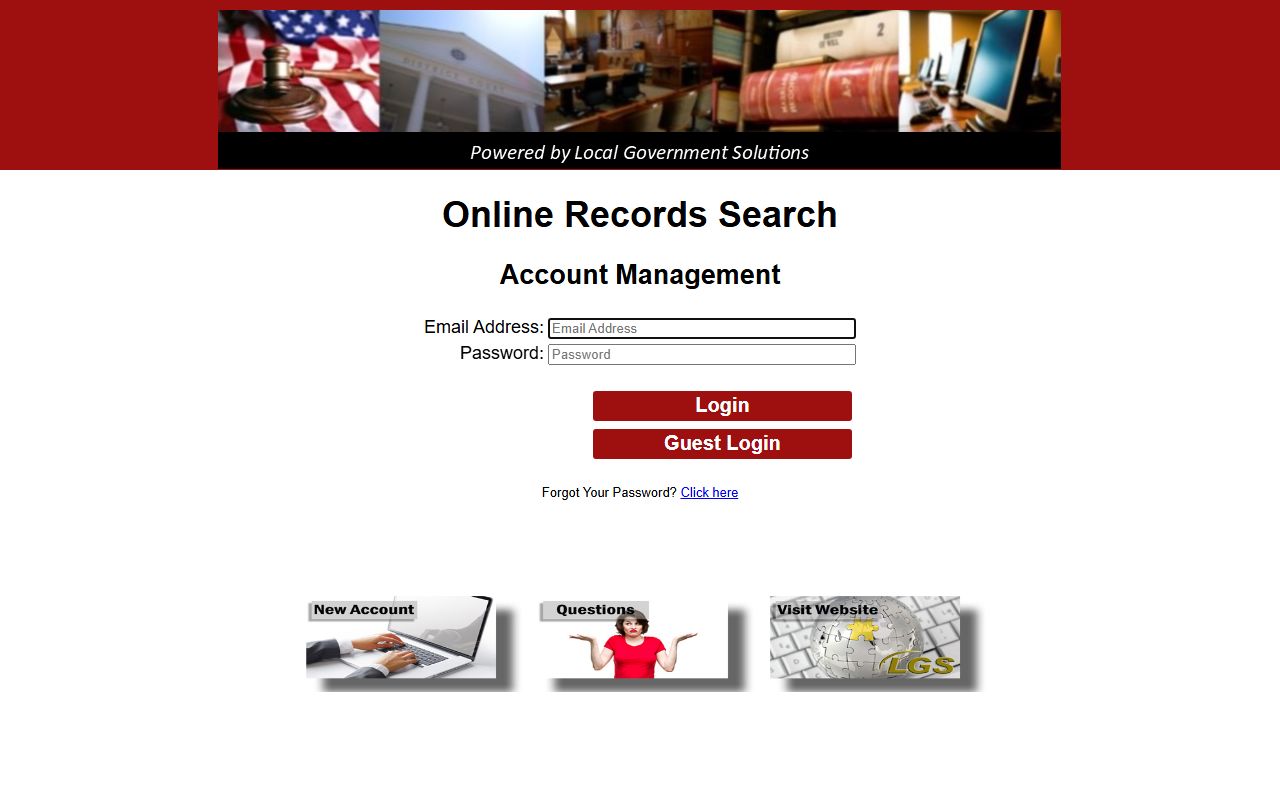
The portal can be reached as a guest or account user, but hidden internal case-search fields were not inspected beyond login during research.
| Visible Field | Type | Notes |
|---|---|---|
| Email Address | Text input | Used for account login and lowercased on blur. |
| Password | Password | Used for account login. |
| Guest Login | Link/button | Visible path before deeper record searching. |
| New Account / Help | Links | Used for account setup or LGS support. |
Find Records After Childress Arrest
Start with custody facts, then move to court filings. If the person was recently booked, IVSS or the jail phone line may be faster than the court portal. If the prosecutor has filed the case, clerk records become the better path. Search spelling variations, because the county clerk page specifically recommends trying alternate spellings and search criteria.
- Confirm jail custody or release through IVSS or the Childress County Sheriff's Office.
- Record name spelling, booking date, arresting agency, and any jail ID or permanent booking number.
- Search the LGS Online Records portal as a guest or account user.
- Try spelling variants and broader date ranges when a result does not appear.
- Contact the County Clerk or District Clerk for older, unindexed, sealed, or certified court files.
- Use Texas DPS Crime Records only for statewide criminal-history services, not as a county case-file substitute.
Childress County Arrest Charge Documents
Three charging-document terms come up often after a jail arrest. A complaint can appear early in the process. An information is filed by a prosecutor, often for misdemeanor matters. An indictment is returned by a grand jury and is common in felony cases. These terms describe how a case is charged; they do not prove guilt by themselves.
| Document | Plain Meaning | Local Use Note |
|---|---|---|
| Complaint | A sworn allegation or charging paper used early in a criminal matter. | May connect to magistrate or initial case activity. |
| Information | A prosecutor-filed charging document. | Often tied to misdemeanors and non-indictment matters. |
| Indictment | A grand-jury charging instrument. | Common felony pathway after prosecutor review. |
Childress County Prosecutor Records
The local prosecutor offices matter because they decide what happens to arrest allegations. The District Attorney page names Luke Inman at 800 West Ave., Box 1, Wellington, TX 79095, phone 806-447-0055, fax 866-233-2738. The County Attorney page names Greg Buckley at 100 Avenue East NW, Suite #2, Childress, TX 79201, phone and fax 940-937-6158. The official county attorney page does not spell out criminal-division duties, so avoid assuming a specific case split beyond the source.
The screenshot below shows the official district attorney contact card. The Childress County District Attorney page is the official source for Luke Inman's listed office contact information.
Prosecutor contact details help identify the office, but public case files and certified copies still route through the clerk or court record process.
Childress County Charge Status
Charge status can change after arrest. A booking entry may reflect the arresting agency's initial charge, while the court record reflects what was filed and what the judge ordered. A court case can be pending, dismissed, reduced, amended, indicted, disposed, sealed, or expunged depending on law and court action.
| Status | Meaning |
|---|---|
| Pending | The court case is open and not finally resolved. |
| Dismissed | The filed case or charge was ended by court or prosecutor action. |
| Amended or reduced | The filed charge changed from the arrest or original filing. |
| Conviction | A final guilty finding, plea, or judgment was entered. |
| Expunction | A qualifying arrest-record clearing process under Texas Code of Criminal Procedure Chapter 55. |
| Comparison | Charge | Conviction |
|---|---|---|
| Legal effect | An accusation or filed count. | A final outcome based on plea, verdict, or judgment. |
| Where seen | Jail booking, complaint, information, indictment, docket. | Judgment, disposition, or sentence records. |
| Comparison | Sealed | Expunged |
|---|---|---|
| Access effect | Public access may be limited by court order. | Qualifying records may be cleared under the expunction process. |
| Next step | Check the court order. | Use the expunction order with agencies that hold records. |
Childress County Arrest Warrants
No official Childress County active-warrant search page was located. The sheriff page says the office serves arrest warrants and civil/legal process, but it does not publish a warrant list, most-wanted page, or direct warrant-search portal. If a warrant leads to jail booking, the person may appear through the custody-status path and later through clerk records if a case event is filed.
A bench warrant or capias often comes from a court after missed court or failure to comply. An arrest warrant authorizes custody on a criminal accusation. A detainer or hold from another county, TDCJ, federal authorities, or ICE can affect release. None of these is proof of conviction.
When a warrant case is not visible online, use a narrow sequence. Call the sheriff for custody or warrant-service questions, search LGS for related court events, and contact the clerk for older or unindexed files. The research did not locate a general public statewide Texas warrant portal, and Texas DPS Crime Records is a criminal-history service rather than a simple county warrant lookup.
Texas DPS Criminal Records
Texas DPS Crime Records is separate from Childress County court files. It can matter when a person needs statewide criminal-history information, but it is not the same as a certified county case docket or a jail booking record. DPS services may have fees, eligibility limits, or fingerprint-based options depending on the request. Use DPS for statewide history questions and use Childress County clerks for filed local case records after a jail arrest.
For a local case, the clerk record remains the better source for docket activity, filed charge wording, orders, and disposition.
Public Record Search
Sponsored Results